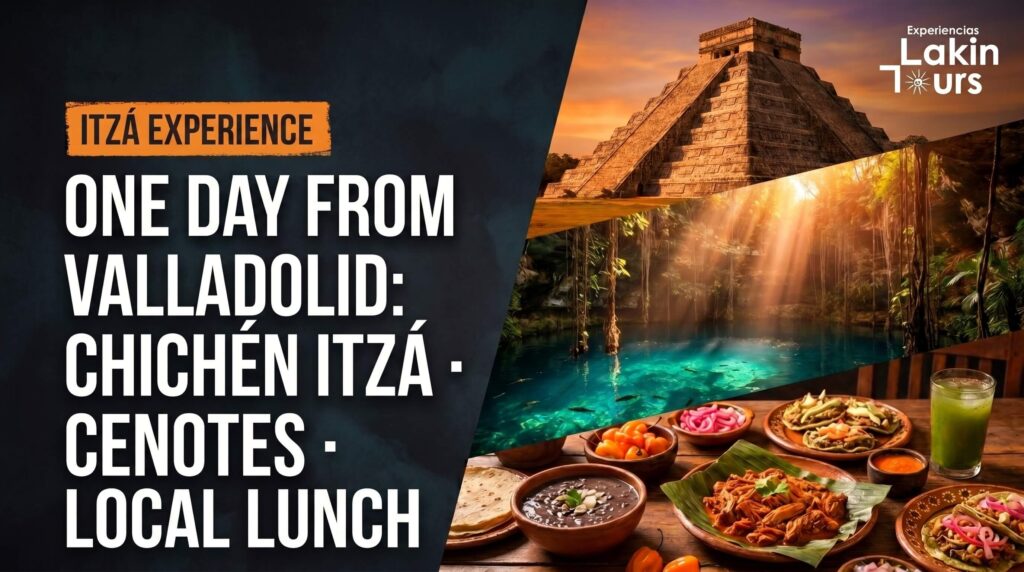
One Day from Valladolid: Chichén Itzá, Three Cenotes and Yucatecan Cuisine
One of the most common mistakes travelers make in Yucatán is underestimating what can be experienced in a single well-organized day. Chichén Itzá, three cenotes and lunch with cochinita pibil at a local restaurant is not a packed itinerary — it is exactly what the Lakin Tours Itzá Experience offers from Valladolid, with enough time to enjoy each stage without rushing. Here is the complete route, hour by hour. Why Leave from Valladolid Instead of Cancún Most tours to Chichén Itzá depart from Cancún or Playa del Carmen, which means two to three hours of travel time in each direction. That transit time significantly reduces the hours available at the archaeological site and at the cenotes. Leaving from Valladolid, the journey to Chichén Itzá takes less than 45 minutes. That difference allows arrival at the site during the first opening window, before the large groups show up, and a return to Valladolid with enough time to keep exploring the city in the afternoon. Hour by Hour Itinerary 7:00 AM — Departure from Valladolid The day begins with pickup at the agreed meeting point in Valladolid. Lakin Tours vehicles have air conditioning and depart on time. The drive to Chichén Itzá takes approximately 40 minutes, and the guide uses that time to provide historical context about the site: who the Itza were, what period the archaeological site represents and which structures will be visited. 8:00 AM — Arrival at Chichén Itzá Arriving at opening time is the single most important variable of the entire day. At 8:00 in the morning, the site has a fraction of the visitor volume it will have two hours later. The light is lateral and warm, ideal for photographing the structures. Temperatures are considerably cooler than at midday. The guided tour covers the main zones of the site: The Castillo de Kukulkán — the nine-tiered stepped pyramid that functions as a calendar in stone. Its 365 steps, distributed across four staircases, represent the days of the solar year. The guide explains the equinox phenomenon and the astronomical precision with which it was designed. The Great Ball Court — the largest court in Mesoamerica, with acoustics so precise that a whispered voice at one end can be clearly heard at the other. The guide demonstrates this phenomenon during the visit. The Temple of the Warriors — a stepped platform flanked by hundreds of sculpted columns depicting warriors, eagles and feathered serpents. It is one of the most impressive architectural complexes on the site. The Observatory (El Caracol) — a circular structure whose windows are aligned with the rising and setting points of Venus at different times of year. It represents the level of astronomical development achieved by Maya civilization. Cenote Xtoloc — the water source within the archaeological site where the Maya offered jade objects, copal and gold in ceremonies connected to water deities. Swimming is not permitted, but standing at its edge with the context provided by the guide is one of the most meaningful stops on the tour. 11:00 AM — Transfer to the First Cenote After approximately three hours at the archaeological site, the group transfers to the first cenote on the circuit. The change of environment is immediate: from the dry heat of the archaeological zone to the coolness of a cavern with underground water at 24 degrees Celsius. 11:30 AM — Ik Kil: the Open Cenote Ik Kil is a collapse-type cenote with a circular opening in the ceiling approximately 60 meters in diameter. The water is about 26 meters below and is accessed by a staircase carved into the rock. From the edge, the view downward — with tree roots descending along the walls and fish swimming in the turquoise water — is one of the most photographed scenes in Yucatán. Time at Ik Kil is sufficient to swim, photograph and explore the surroundings at a relaxed pace before moving on to the next cenote. 1:00 PM — Lunch at a Local Restaurant The midday break is at a traditional Yucatecan restaurant in the area. The menu includes the most representative dishes of regional cuisine: Cochinita pibil — pork marinated in achiote and sour orange, slow-cooked in an underground oven. It is Yucatán’s most iconic dish and in this area it is prepared using techniques that have not changed in generations. Sopa de lima — chicken broth with sour lime juice, fried tortilla strips and herbs. A light dish that contrasts perfectly with the midday heat. Handmade tortillas — a fundamental part of any authentic Yucatecan meal, they accompany all the main dishes. Lunch is a stage of the tour that many large groups skip or replace with a quick stop at a food chain. In the Itzá Experience, it is a designed pause to rest, eat well and experience an aspect of local culture that no travel guide captures. 2:30 PM — Xkekén and Samulá: the Cave Cenotes Xkekén and Samulá are cave-type cenotes: they are accessed through an opening in the rock and the interior is partially illuminated by natural light entering from above. They are completely different from Ik Kil, and that variety is part of the circuit’s design. Xkekén — also known as Dzitnup, this cenote has a rock vault with a small circular opening in the ceiling through which a shaft of light illuminates the blue-green water inside. Stalactites hang from the ceiling and tree roots descend along the walls until they touch the water. Samulá — a few meters from Xkekén, this cenote has similar characteristics but a different color palette: the water tends toward a deeper blue and the rock formations inside are more pronounced. Many visitors consider Samulá the most photogenic of the two. Both cenotes allow swimming. The water maintains a constant temperature between 24 and 26 degrees Celsius throughout the year. 4:30 PM — Return to Valladolid The return journey takes approximately 30 minutes. The group arrives back in Valladolid with afternoon light, with enough time to walk through the historic center, visit Cenote Zací, have dinner at one of