Chichén Itzá receives more than two million visitors every year. Most of them leave with the same photographs, the same facts and the same surface impression of having seen a famous pyramid. What separates that visit from a real experience is not the site — it is who tells you about it.
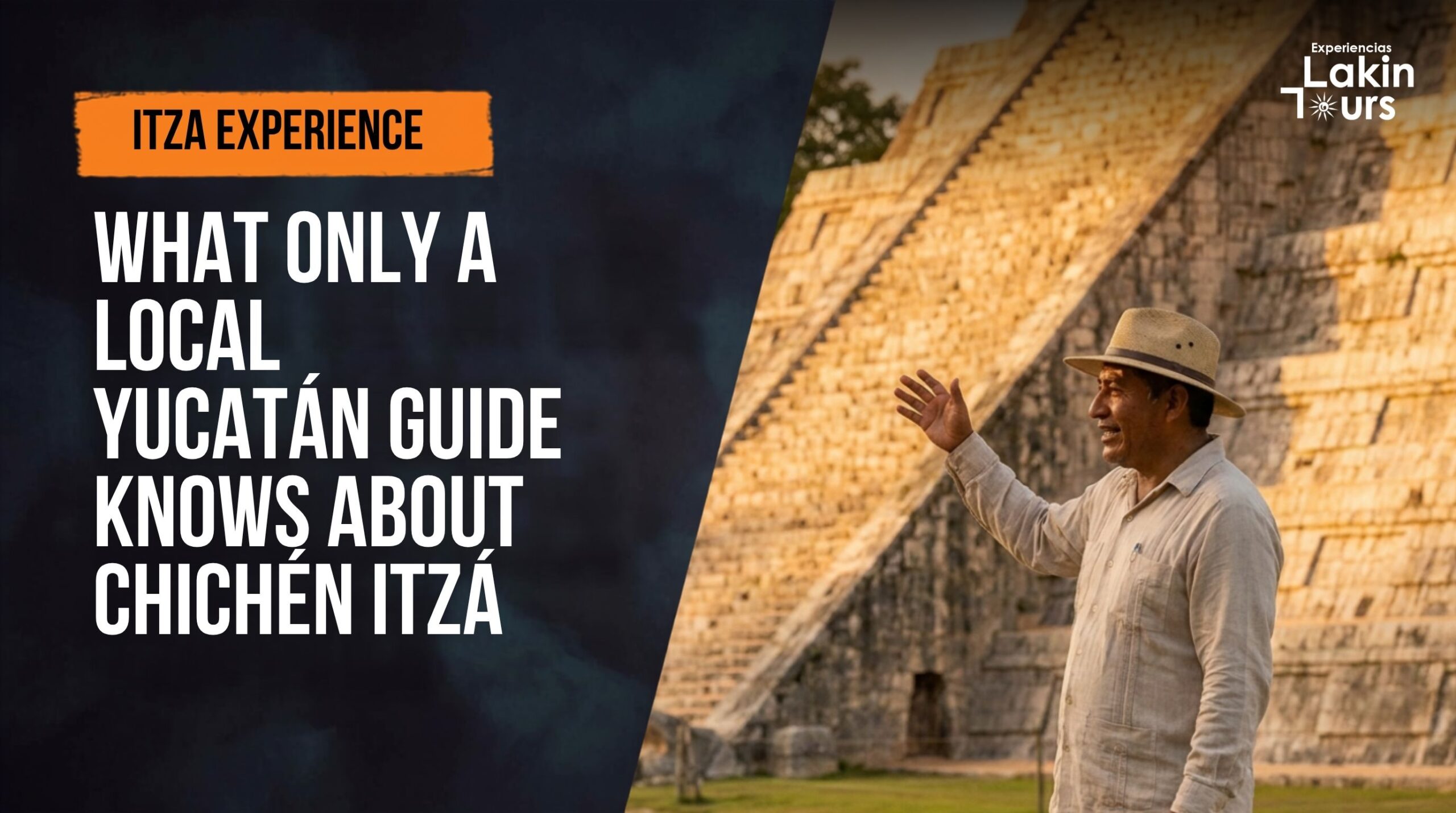
Lakin Tours guides are not professionals trained at Cancún travel agencies. They are people who were born and grew up in Valladolid and the surrounding municipalities, in communities that have lived alongside Maya history for centuries. They heard these stories from their grandparents long before learning them in any book. That difference is noticeable from the first minutes of the tour.
Here is what a local Yucatán guide knows about Chichén Itzá that most visitors never get to discover.
1. The Castillo de Kukulkán Is Not Just a Pyramid: It Is a Clock, a Calendar and a Musical Instrument
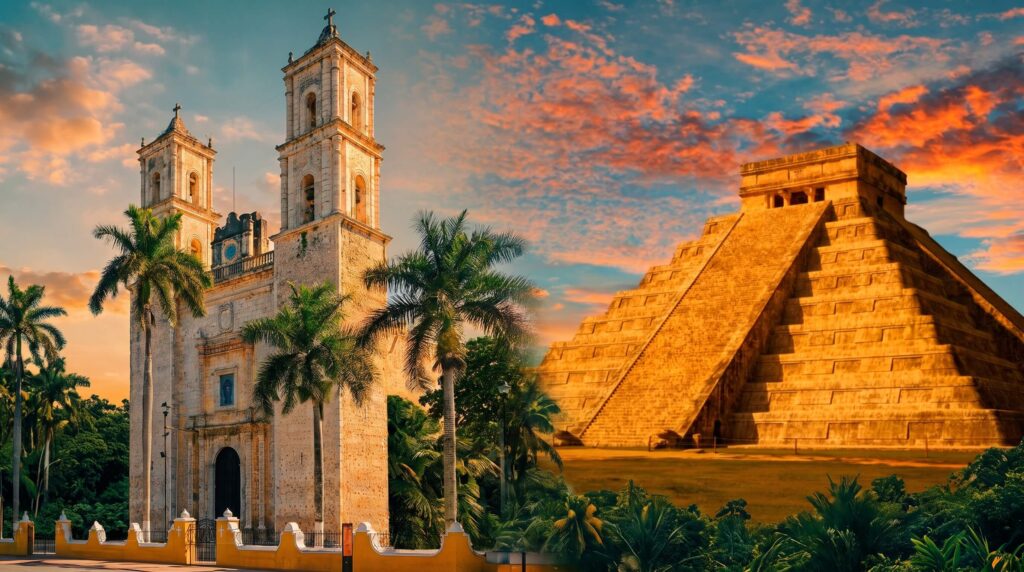
Most visitors arrive, photograph the Castillo de Kukulkán and move on. Few stop to understand that what they are looking at is not just a temple — it is one of the most functionally precise objects any civilization has ever built in human history.
As a calendar: the pyramid has exactly 365 steps distributed across four staircases of 91 steps each, plus the upper platform. Each step represents a day of the solar year. The 52 panels at the base represent the 52-year Maya cycle, the point at which the solar and ritual calendars coincide.
As a solar clock: during the spring and autumn equinoxes (March 21 and September 21), sunlight creates a series of shadow triangles on the northern staircase that simulate a serpent descending toward the stone head at the base. The effect lasts approximately 45 minutes. The Maya did not calculate this by accident — it required generations of astronomical observation to achieve.
As an acoustic instrument: if someone stands in front of the main staircase and claps, the returning echo has a frequency very similar to the call of the quetzal, the bird of greatest significance in Maya iconography. Acoustic researchers have documented this phenomenon and concluded it is not coincidental: the angle of the steps and the building material were calculated to produce that specific effect.
A local guide who grew up in Yucatán does not only know these facts — they know the discussions their community has had for generations about what they mean. That is what turns the explanation into something completely different from reading an information board.
2. The Ball Court Is the Most Sophisticated Stadium the Ancient World Ever Built
The Great Ball Court at Chichén Itzá is the largest in Mesoamerica: 168 meters long and 70 meters wide. But its size is the least interesting fact about it.
The acoustics: a person standing at one end of the court can speak in a normal voice and be heard clearly by someone at the opposite end, more than 100 meters away, with no amplification system. The guide demonstrates this phenomenon on every visit and the group’s reaction is always the same: disbelief followed by fascination.
The acoustic engineers who have studied the site have not been able to determine with certainty whether this effect was intentional or emerged naturally from the design. Lakin’s local guides have their own perspective on this question — a perspective shaped not only by academic training but by years of living alongside the stories of the region.
The stone rings: the hoops through which players had to pass the ball are located seven meters high. The solid rubber ball weighed several kilograms and the rules prohibited using hands or feet — only hips, elbows and knees. Getting that ball through that hoop was not a skill developed in a single season.
What the books do not say: the reliefs carved on the lateral walls of the court show game scenes with a level of detail that makes it possible to understand the clothing, protective equipment and associated rituals. A local guide who knows those images by memory can point out details that most visitors miss entirely.
3. Cenote Xtoloc: the Water Source That Supplied a City
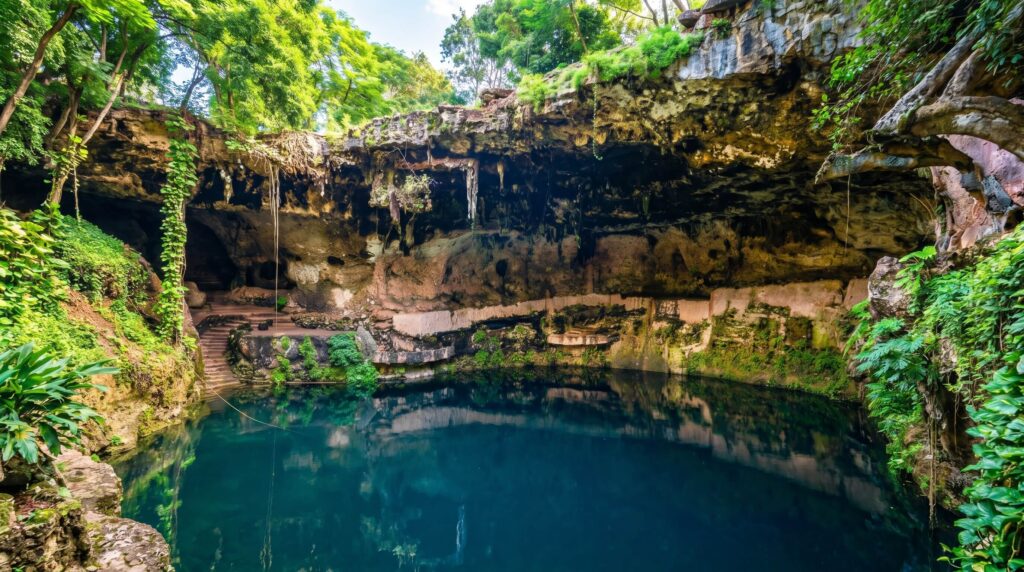
Inside the archaeological site of Chichén Itzá there is a cenote that most tours do not visit because it is not on the main route. It is called Cenote Xtoloc and it is located south of the Castillo de Kukulkán.
While the cenote to the north of the site was where offerings to water deities were made, the Xtoloc was the city’s everyday water source. This is where people drank. Where laundry was washed. Where the containers that supplied a city of possibly 50,000 to 100,000 people at its peak were filled.
Lakin guides who grew up in communities with cenotes near their homes understand that relationship in a way that cannot be learned from a manual. The underground water of Yucatán is not a tourist resource — it is the axis around which life on the Peninsula has been organized for millennia. That perspective completely changes the way of looking at a cenote inside an archaeological site.
4. The Temple of the Warriors and the Connections Nobody Mentions
The Temple of the Warriors is one of the largest structures on the site and yet receives less attention than the Castillo precisely because it stands in its shadow. That is a mistake.
The similarity between the Temple of the Warriors and Temple B at Tula, in the state of Hidalgo, is so pronounced that archaeologists have spent decades debating what it means. Both have the same arrangement of columns, the same reliefs of eagles and jaguars, the same type of reclining figure called a Chac Mool at the top. Two cities separated by more than a thousand kilometers built nearly identical structures.
This was not coincidence. It was the result of a commercial and cultural exchange network that connected civilizations across all of Mesoamerica. Chichén Itzá was not an isolated city in the jungle: it was a central node in a network that stretched from central Mexico to Central America.
A local Yucatán guide who knows the history of the region’s pre-Hispanic trade routes can place Chichén Itzá in that broader context. It is the difference between seeing an impressive structure and understanding what it represents in the history of a continent.
5. The Observatory: the Clearest Evidence That the Maya Were the Best Astronomers of the Ancient World
El Caracol — named for the spiral staircase inside — is a cylindrical tower that functions as an astronomical observatory. Its windows are aligned with millimeter precision with the rising and setting points of Venus at different times of year.
Venus held central importance in Maya cosmology. The Maya calculated the synodic cycle of Venus (the time it takes to return to the same position in the sky as seen from Earth) with a margin of error of just two hours over 500 years. For comparison: European astronomers did not reach that precision until the 17th century, using telescopes.
Lakin guides who grew up in Yucatán know the relationship between Venus and the agricultural calendar of present-day Maya communities. That tradition of sky observation did not disappear with the conquest — it adapted, it blended with other practices and in many rural communities on the Peninsula it remains part of how decisions about planting corn are made. A local guide can trace that line from the Observatory at Chichén Itzá to the practices their own family continues today.
6. The Structures That Most Tours Never Visit
The archaeological site of Chichén Itzá covers nearly 5 square kilometers. Mass tours visit between 20 and 30 percent of that area. The rest — secondary temples, ceremonial platforms, residential structures — falls outside the standard circuit due to time constraints.
With small groups and more relaxed pacing, Lakin guides can include stops at areas most visitors never see:
The Group of a Thousand Columns: a set of columns that originally supported roofs of perishable material, forming covered galleries around open courtyards. At sunset, when the light is lateral, the shadows cast by the columns create one of the most striking images on the site.
The Platform of Venus: a square platform decorated with reliefs of the morning star, used for ceremonies associated with the cycle of Venus. It is a few meters from the Castillo but most groups walk past without stopping.
The Tzompantli (Platform of the Skulls): a platform whose walls are covered with reliefs of human skulls in a row. Its function and meaning are part of the most compelling discussions that can be had with a guide who knows Maya iconography in depth.
Why the Local Background of the Guides Matters
A certified guide of any background can learn the historical and archaeological facts about Chichén Itzá. That is what official training covers. But there is a type of knowledge that is not in the manuals and cannot be learned through study: the knowledge that comes from having grown up in a culture that has been in contact with that heritage for centuries.
Lakin Tours guides grew up in families where stories of the Maya world were not textbook content but part of everyday conversation. Some have grandparents who still use the Maya calendar to make agricultural decisions. Some grew up in communities where Yucatecan Maya is still the primary language spoken at home.
That cultural proximity does not make a guide more “authentic” in the tourist sense of the word. It makes them someone who can offer a perspective that no outsider can replicate: the perspective of someone who looks at Chichén Itzá not as a ruin from the past but as a living part of their own history.
Frequently Asked Questions
Do Lakin Tours guides speak English?
Yes. All guides speak Spanish and English. Mixed groups are common and the guide alternates between the two languages throughout the tour.
Does the tour cover all areas of the site?
The tour covers the main zones and some secondary areas depending on the group’s interests and available time. With small groups there is more flexibility to stop at structures that mass tours walk past.
Can questions be asked during the tour?
It is one of the most valued advantages of the small group format. The guide answers questions throughout the tour and adapts explanations based on the participants’ interests.
Does the guide also explain the cenotes?
Yes. During transfers and at each cenote on the circuit, the guide provides context about the relationship between underground water, Maya cosmology and the everyday life of communities in the region.