Yucatán has more than 6,000 registered cenotes. Most travelers visit one or two during their stay and leave with a feeling that there was more to see. They are right.
Less than an hour from Valladolid, there is a circuit of four cenotes that brings together the most distinct types of underground formation the Peninsula has to offer: open cenote, semi-open cenote and two cave cenotes. Visiting all four in a single day is not only possible — it is the most complete way to understand why Yucatán’s cenotes are unlike anywhere else in the world.
This is the guide to the four cenotes that make up the Lakin Tours Xibalbá Experience.
What Is a Cenote and Why Does Yucatán Have So Many
A cenote is an underground cavern whose ceiling has partially or fully collapsed, exposing the groundwater that flows beneath the Yucatán Peninsula. The word comes from the Maya ts’onot, meaning “cavern with water.”
The reason Yucatán concentrates the highest density of cenotes on the planet has to do with its geology: the Peninsula’s soil is composed almost entirely of limestone, a porous material that water slowly dissolves over thousands of years, creating underground caverns and tunnels. When the ceiling of these caverns collapses, a cenote is born.
The water that fills the cenotes comes from rainfall that filters through the rock and forms the largest known underground water system in the world, called the Ox Bel Ha System. This system interconnects caverns, underground rivers and cenotes across hundreds of kilometers beneath the Peninsula.
1. Ik Kil — The Most Photographed Open Cenote in Yucatán
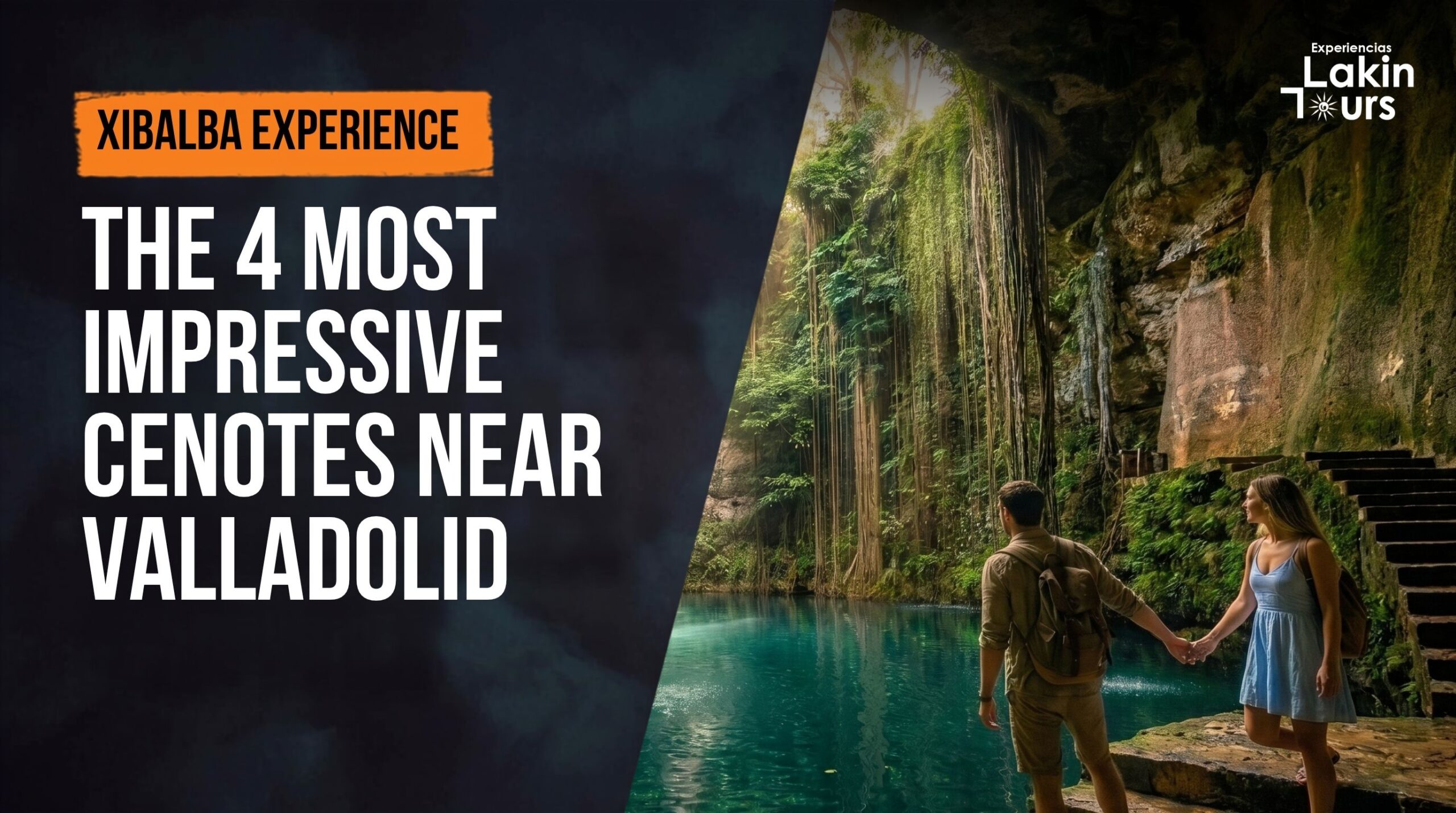
Ik Kil is a full-collapse cenote: its ceiling fell completely thousands of years ago, leaving a circular opening approximately 60 meters in diameter that now frames the sky from the bottom. It is accessed by a staircase carved into the limestone that descends about 26 meters to water level.
What makes Ik Kil visually unique is the combination of elements that converge in that space: the roots of trees growing at the edges and descending along the walls almost to the water, the fish swimming visibly from the surface, the overhead light entering directly from above during midday hours and the vertical limestone walls surrounding the water on all sides.
It is one of the most photographed cenotes in Yucatán and that reputation is fully justified. The view from the edge looking down and the view from the water looking up are two of the most iconic images of the region.
Type: Open cenote (full collapse)
Depth: more than 40 meters
Water temperature: 24–26°C
Access: by staircase carved into rock
Distance from Valladolid: approximately 50 minutes
2. Xcajum — The Semi-Open Cenote Least Known to Mass Tourism
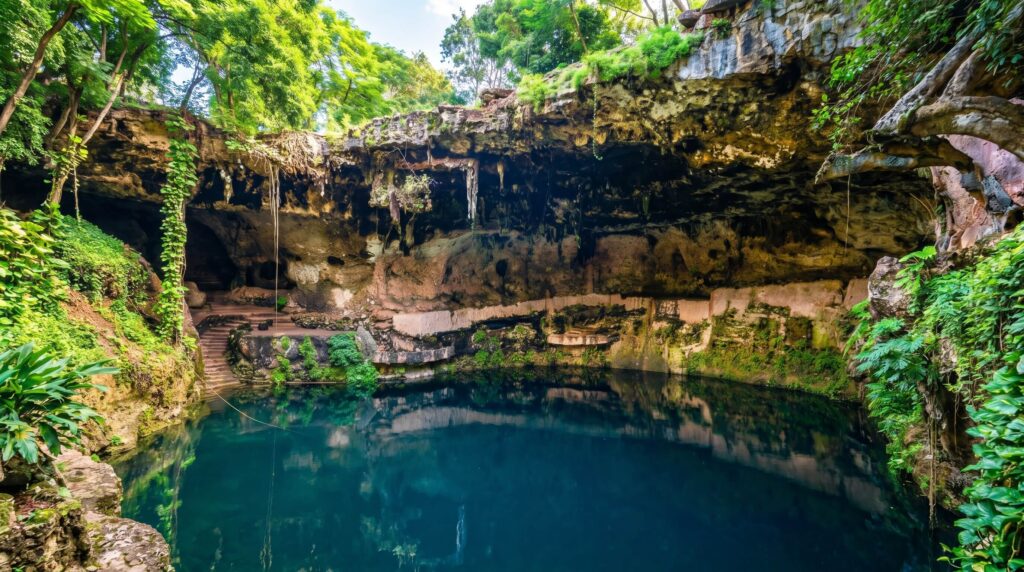
Xcajum is the least visited cenote among mass tours and, precisely for that reason, one of the most valued by those who discover it. It is a semi-open cenote: part of its ceiling remains intact, creating a shaded and cool zone that contrasts with the illuminated area where natural light enters.
The water at Xcajum has a different coloration from the other cenotes on the circuit: greener tones, a result of the vegetation surrounding its edges and the lower amount of direct light it receives. The atmosphere inside the cenote is more intimate and quiet than Ik Kil, and the less developed natural surroundings give it a wilder character.
For travelers looking for a less touristy experience closer to what swimming in a cenote must have felt like before they became mass attractions, Xcajum is the stop that stays with them most from the circuit.
Type: Semi-open cenote
Water temperature: 24–26°C
Atmosphere: intimate, less crowded
Distance from Valladolid: approximately 45 minutes
3. Xkekén — The Cave Cenote with Yucatán’s Most Famous Light Beam
Xkekén is a cave cenote: it is accessed through an opening in the rock and the interior is covered by a limestone vault. The only source of natural light is a small circular opening in the ceiling through which a shaft of light enters and illuminates the water with an almost theatrical precision.
That light beam is Xkekén’s most recognizable feature. Depending on the time of day and the position of the sun, the angle shifts and the effect on the water varies between an intense blue and a bright turquoise. The stalactites hanging from the ceiling and the rock formations on the walls complete an atmosphere that has no comparison with any open cenote.
The sensation of swimming inside an underground cavern is completely different from the experience at Ik Kil or Xcajum. Many travelers describe Xkekén as the cenote that surprised them most on the circuit, precisely because the expectation of being underground contrasts with the beauty of the interior space.
Type: Cave cenote
Water temperature: 24–26°C
Main feature: overhead light beam
Access: by staircase, covered interior
Distance from Valladolid: approximately 15 minutes
4. Samulá — The Cave Cenote with the Most Spectacular Roots
Samulá is a few meters from Xkekén and shares the same type of formation — cavern with a stone vault and an opening in the ceiling — but has a personality entirely its own that sets it apart from its neighbor.
The most striking feature of Samulá are the tree roots that descend from the cavern ceiling almost to the water surface. Some of these roots are several meters long and create an organic curtain that frames the water from above. The combination of roots, stalactites, deep blue water and filtered natural light generates one of the most photogenic scenes in the entire Yucatán cenote circuit.
The water at Samulá tends toward a darker, deeper blue than Xkekén. The rock formations at the bottom are more pronounced and on days with good visibility they can be seen from the surface. Many visitors consider Samulá the most photogenic of the four, though the choice between Xkekén and Samulá tends to divide groups.
Type: Cave cenote
Water temperature: 24–26°C
Main feature: descending roots and deep blue water
Access: by staircase, covered interior
Distance from Valladolid: approximately 15 minutes
Why Visit All Four in a Single Day
Most tours include two or three cenotes. The Lakin Tours Xibalbá Experience includes all four precisely because each one contributes something the others do not.
Ik Kil delivers the open cenote experience with all the visual spectacle that implies. Xcajum provides intimacy and a less developed natural setting. Xkekén introduces the visitor to the world of underground caverns through its characteristic light beam. And Samulá closes the circuit with the most dramatic and photogenic scene of the four.
Moving through them in that order, with enough time at each one and without the rush of a mass tour, is the difference between having seen cenotes and having understood what makes Yucatán special.
Important Rules for Visiting the Cenotes
Biodegradable sunscreen is mandatory — conventional sunscreen contains chemical compounds that contaminate the underground water and damage the aquatic ecosystem. At all cenotes on the Xibalbá circuit, certified biodegradable sunscreen or no product at all is required before entering the water.
Do not touch the rock formations — the stalactites and calcite formations visible in the cave cenotes take thousands of years to form. Contact with hands causes irreversible deterioration.
Do not bring food or drinks into the water — to protect the aquatic ecosystem and water quality.
Life jackets available — at all cenotes on the circuit, life jackets are available for those who do not swim or prefer to float.
What to Bring for the Cenote Day
Swimsuit worn from the moment of departure — saves time between cenotes.
Compact or microfiber towel — lightweight and quick-drying.
Biodegradable sunscreen — apply before leaving the hotel.
Waterproof bag — for the phone and documents while swimming.
Water sandals with grip — cenote access points have wet steps.
A change of dry clothes — for the return to Valladolid.
Cash — for individual entrance fees at each cenote.
Frequently Asked Questions
Can these four cenotes be visited independently?
Yes, but it requires personal transportation between them as they are not within walking distance of each other. Ik Kil is in the Chichén Itzá area while Xcajum, Xkekén and Samulá are near Valladolid. Organizing it independently means coordinating transfers between the two groups of cenotes.
What is the best time to visit the cenotes?
In the morning, between 9:00 AM and 1:00 PM, when there are fewer visitors and the natural light in the cave cenotes is most intense. At Xkekén and Samulá, the overhead light beam is most dramatic during the central hours of the day.
Is it suitable for children?
Yes. All four cenotes have controlled access and life jackets available. Constant supervision in the water is recommended, along with extra biodegradable sunscreen for younger children.
Can photography be done inside the cave cenotes?
Yes. There are no restrictions on personal photography. For best results at Xkekén and Samulá, use the night mode on a phone or a camera with good ISO sensitivity to capture the interior light without flash.